
A reflection on what effective creative work can do for a non-profit, and what agencies should understand before offering it.
Since it is a non-profit organization, creative work has a special responsibility. It needs to draw people’s attention and motivate them to act, while at the same time earning the trust of people who may never meet.
A donor usually does not see the immediate effect of the amount they have donated. A volunteer is likely to work in only one section of the organization. Someone asking for assistance might already have an opinion before speaking to any staff member. In all these situations, the organization’s words, images, and other materials help people work out what it stands for and whether they feel at ease taking the next step.
Design therefore involves more than just presentation; it is a factor in making the mission visible, understandable, and credible.
The most effective non-profit creative work can show what is important, present people with respect, and give staff and volunteers the means to communicate in a consistent manner. It also must consider the actual situation in the sector: budgets are limited, teams are small, there are competing priorities, and the tools used must remain useful after the organization has left.
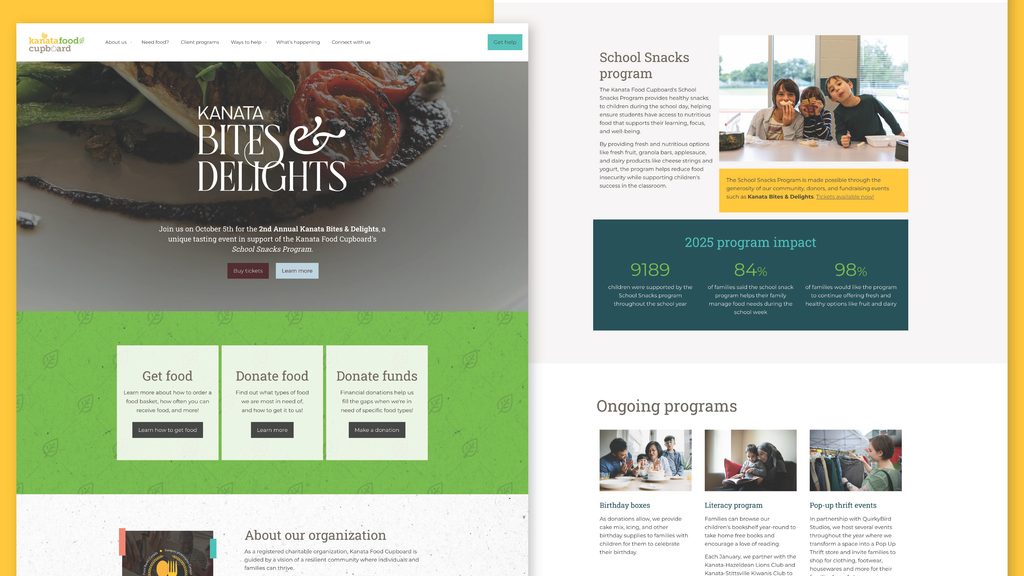
The principles have become concrete through our work with the Kanata Food Cupboard. During the five years in question, the problem has not been reestablishing an organization with strong ties to its community, but rather helping its current mission become more noticeable, more consistent, and easier for its team to promote.

The first job of creative is to make people care
In essence, non-profits want to raise awareness and encourage people to act; creative work achieves this by establishing an emotional link between the organization’s mission and the public it wishes to reach.
Such connections are usually established rapidly. A person who happens to pass a donation bin might spend only a few seconds looking at it. A possible volunteer could come across a single social post. A funder might start to form an opinion before getting to the main part of an application.
Good creative work ensures that such moments are worthwhile; it can turn an abstract issue into something immediate, make a complicated subject simpler to understand, or provide someone with a clear means of taking part.
For the Kanata Food Cupboard, the in-store signage represents one of those key instances. When someone passes by a donation bin, they are generally occupied with something else. The message must be picked up at once, and the action involved must seem simple. That is why we kept the signs straightforward and added a touch of playfulness, since donating doesn’t always have to carry a serious tone. It can instead feel easy, positive, and linked to the normal thing one does when shopping.
One of the most valuable things that creatives can do for a non-profit organization is to reduce the gap between caring and acting.
Trust is part of the work
A commercial brand usually gets people to want something, while a non-profit tends to get people to believe in something: that its work is necessary, its method is responsible, and that their contribution will be handled with care.
Since most of the supporters cannot carry out a personal audit of the organization, they form an opinion based on what they can observe, such as the website, the reports, the events, the signage, the social media, and the way they interact with staff or volunteers.
Design does not constitute evidence of an organization’s effectiveness, and our attention to detail must never be mistaken for real impact. Yet clear and consistent communication does help an organization seem thoughtful, capable, and serious in its duties. When things are recognized, they become familiar, and familiarity can in turn lead to trust.
At the time we started working with the Kanata Food Cupboard it already had over thirty-five years’ experience in building up its reputation. It had amassed a number of capable but irregular creative resources; these having been produced in response to individual needs and without any clear visual connection between them.
What we were aiming for was not the creation of credibility; rather, it was to assist the organization in conveying the credibility it had already gained.
We updated the logo and created an identity system which would make our communications identifiable, accessible, and flexible enough to suit different audiences and situations.
Representation is a design decision
Effective campaigning often arises in cases where people are going through hard situations, and this situation imposes a responsibility in addition to that of producing an effective campaign.
There is a temptation to make the emotional content of the communications carried out by an organization bear entirely on the people it serves. While images of hardship may draw attention, short-term effectiveness is not the only factor to be considered.
A good way to decide this is to consider whether the individual in question would feel at ease looking at the image together with its caption. Would they see themselves reflected in the account? Does the piece grant them dignity and a sense of agency, or does it instead portray them merely in terms of the difficulty they are going through?
There are instances when photography is suitable and has great impact; in other cases, the emotional effect can be achieved through writing, illustration, objects, or through ordinary moments. It is not necessary for a beneficiary’s face to appear in the campaign.
The same level of attention should be given to language. The words an organization employs to describe people appear in its emails, reports, signage, volunteer training, and in its dealings with the public. The vocabulary used can have a greater impact on shaping culture than a logo or typeface.
The Kanata Food Cupboard refers to the people who use its service as “clients.” The word is deliberately ordinary and transactional. Shopping for groceries is something ordinary people do, and framing the service that way helps normalize the experience. It avoids defining people by a temporary circumstance or turning them into a category created for fundraising.
Design for the people who will use it
Most non-profit organizations do not employ their own design team, and the individual who puts together the social media post on Tuesday could be a volunteer who has only twenty minutes and is juggling a number of other duties as well. This alters the creative problem.
The output cannot just consist of a refined campaign or a set of professional files; it has to be a practical system which allows people to run on their own without the need (or a limited need) for the agency. This could involve adaptable templates, accessible options for type and colour, simple guidance, and tools that the organization is already familiar with.
We created day-to-day templates for the Kanata Food Cupboard using Canva. Although it may not be the tool that we ourselves would have picked for our studio, it is one that their team and volunteers are able to access and use. A system which is beautiful but nobody from staff can operate is not a viable solution.
Organizations should also realize that when creative systems enter the world, they change. Logos get stretched, colours shift, templates are use in ways for which they were not intended, and new volunteers turn up without having read the guidelines.
Part of this can be avoided by careful design, training, and providing support. Another part is just the way of operating in an organization that has volunteers actively involved. A system’s value does not lie in it staying perfect; it lies in its ability to keep communicating clearly when the agency is not present.
Put limited resources where they matter most
Although non-profits need clarity and consistency, they usually do not have unlimited resources, so it is necessary to prioritize. It is not necessary to redesign every touchpoint at the same time, since the most valuable opportunities usually occur when communication influences a significant decision.
It could be a donation page on which supporters are dwindling, a campaign designed to help staff explain an unfamiliar issue, an impact report prepared to keep funder relationships going, or some signage which prompts action at the right moment.
A well-made video can be used for events, presentations, fundraising, and on social media; meanwhile, a good template system can enhance hundreds of ordinary communications instead of creating a single perfectly executed campaign.
The answer will vary from one organization to another, the aim being to determine how creative work can serve to eliminate friction, enhance understanding, or strengthen an important relationship.
Measure what the work can honestly influence
Care is needed when measuring creative impact in the non-profit sector.
For a food bank, a rise in demand could be an indication of greater need in the community rather than the result of better marketing. To regard that rise as a sign of creative success would misrepresent the organization’s purpose.
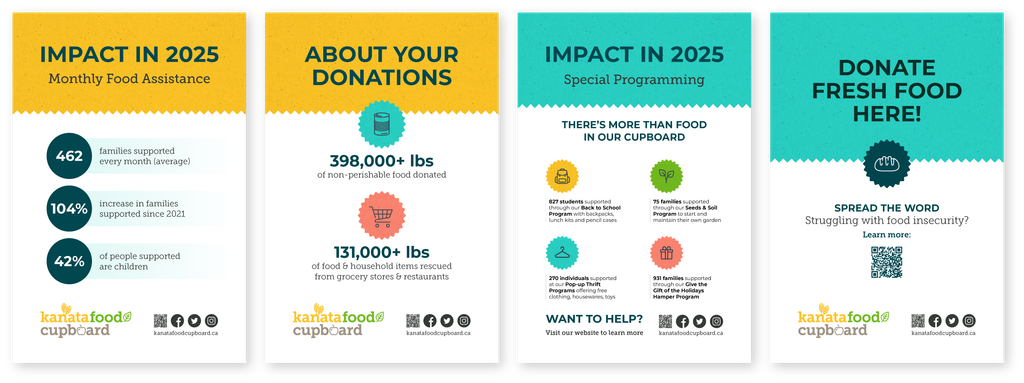
There is no chart available to show that our activities led to an increase in the Kanata Food Cupboard’s impact, since the organization functions within economic and social conditions that are much broader than any campaign, and it would be difficult to justify clean attribution. It doesn’t make it impossible to carry out an evaluation; it just means that we should ask more useful questions.
Is the information that people are looking for being found? Can the volunteers produce the materials on their own, without having to ask for outside assistance? Is the organization conveying its message more consistently? Are the opportunities for donation easier to understand? Do the staff feel that they are better prepared to explain the mission? Creative work needs to be accountable, but it must assert only those results which it can reasonably affect.
When design becomes conviction
Non-profits do not need design simply to appear more established. They need it to clarify their mission, build trust, represent people responsibly, and make action easier.
The best creative work, and what we strive to do at Initiate, strengthens the organization without overshadowing it. It helps people understand what matters, why it matters, and how they can take part. When it succeeds, it does not feel like decoration. It feels like conviction.
If you are interested in supporting the Kanata Food Cupboard, visit https://www.kanatafoodcupboard.ca/ways-to-help/
Share


About the author